A Love Letter to the AI Skeptics: Why There’s Reason for Optimism
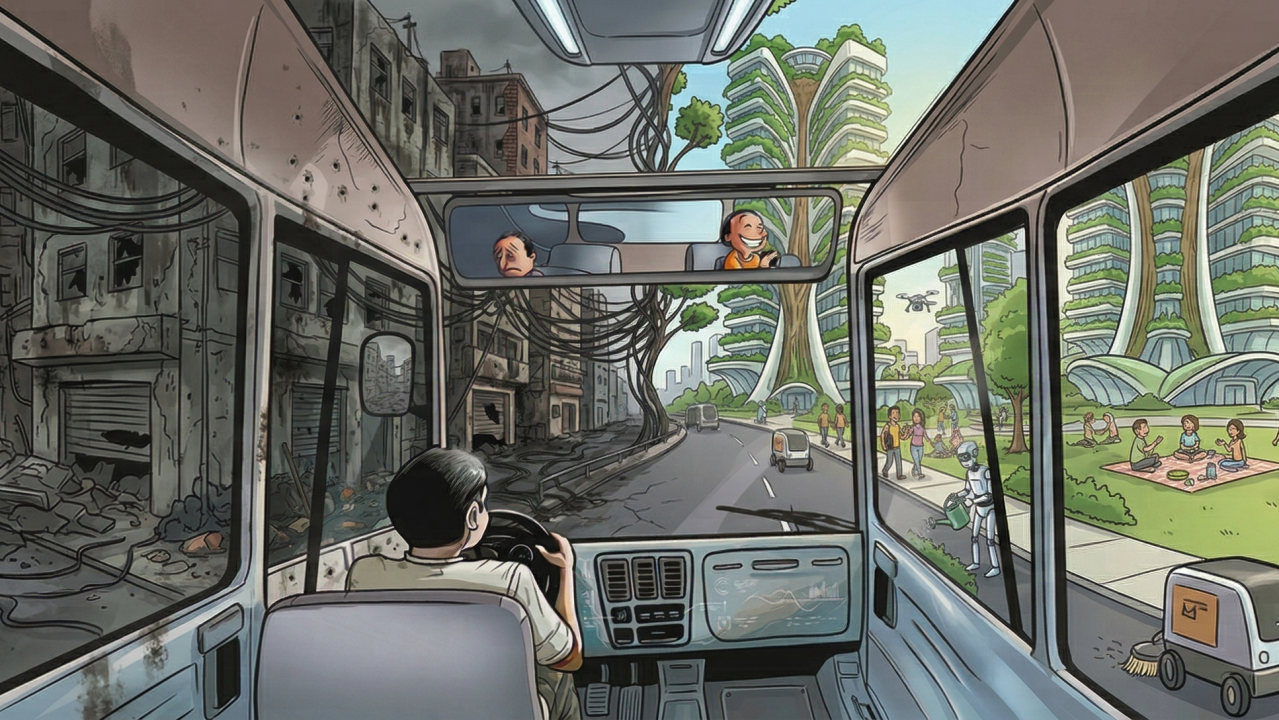
have been called a glass-half-full person for most of my career, and I have never once taken that as an insult. In a world that increasingly mistakes cynicism for intelligence and anxiety for depth, I have come to believe that optimism is not naive at all. It is a discipline. It is a decision. It is, in many ways, an act of courage.
Right now, we are surrounded by people who seem almost emotionally committed to telling the darkest possible story about the future. Every conversation about technology somehow slides toward collapse. Every conversation about AI seems to arrive at the same exhausted conclusion, that we should mostly be afraid, mostly pull back, and mostly brace ourselves for loss. Of course, there are risks. Of course, there are serious questions. Of course, we need ethics, regulation, discernment, and accountability. But I cannot help feeling that something has gone wrong in the spirit of the conversation when awe has disappeared entirely and when gratitude has become almost unfashionable.
Because if we are honest, and if we are willing to step back from the panic of the daily news cycle, this is an astonishing moment to be alive. We are living in a time of extraordinary human capability, and I do not think we talk nearly enough about what a privilege that is. We speak so often about what might go wrong that we forget to notice what is already going right. We forget that we are surrounded by tools, discoveries, and forms of connection that previous generations would have considered miraculous. We forget that progress has always arrived carrying complexity, and that complexity is not the same thing as doom.
I feel this especially when I think about my own family. My father is sick with Parkinson’s. My mother is living with Alzheimer’s. There is nothing abstract about that kind of reality. It is intimate, exhausting, heartbreaking, and deeply humbling. It changes the way you listen to people. It changes the way you hear conversations about innovation, because suddenly you are no longer interested in clever posturing about whether technology feels unsettling. You care about whether something can actually help. You care about whether a system can notice a change earlier than a human eye might, whether it can help manage medications and appointments, whether it can reduce confusion, whether it can give a caregiver a little relief, whether it can preserve a little more dignity, a little more continuity, a little more independence for people you love.
When technology enters that kind of space, it stops being theoretical. It stops being a trend deck and starts becoming a form of mercy. That is why I find the flattening of AI into one big fear story so frustrating. People talk as though the only morally serious posture is suspicion, but that is a luxury of distance. When you have watched illness rearrange a family, you do not dismiss the possibility that better tools could ease suffering. You do not roll your eyes at the idea that intelligence, whether human or machine-augmented, might help us care for one another more effectively. You do not treat that as hype. You treat it as hope.
The same is true in healthcare more broadly. We are entering an era in which earlier detection, better pattern recognition, more personalized treatment, and smarter systems of prevention are no longer fantasies. They are becoming part of the architecture of reality. That should stop us in our tracks. There are very few moments in history when a generation can say, with a straight face, that we may be participating in a meaningful reduction of human suffering at scale. We may be one of those generations. That should not make us arrogant, but it should make us grateful.
And it is not only healthcare. It is the capability itself that is being reimagined. We are seeing systems that help people communicate differently, move differently, navigate differently, and participate more fully in the world after injury or limitation. We are seeing technology not simply as a convenience, but as a way of restoring agency. For all the noise and nonsense that surrounds this moment, that remains the thing I cannot get over: we are building tools that, at their best, expand what a human life can be.
I have also been thinking a lot about what this moment looks like beyond the narrow lens through which the West so often views innovation. A friend of mine was recently telling me about the impact AI is already having across parts of Africa, and what struck me was not some glossy narrative about disruption. It was the grounded, practical beauty of people using these tools to solve real problems, create new access, build businesses faster, and leap over barriers that used to feel permanent. She was talking about entrepreneurs, educators, builders, and communities not waiting for permission to participate in the future, but actively shaping it for themselves. That matters to me because it is a reminder that the story of technological progress does not belong to one geography, one company, or one class of people. There is extraordinary news coming from places the global narrative too often reduces to challenge alone, and I think we have a responsibility to tell those stories too. Hope should not be provincial. Possibility should not be gatekept.
And then, of course, I think about Ella.
When I look at my niece, I do not want to hand her a worldview built out of inherited panic. I do not want her to absorb the stale anxieties of adults who have decided that fear sounds more sophisticated than faith. I do not want her to grow up believing that the future is something that happens to her while she stands in the doorway trying to protect herself from it. I want her to understand that she was born into a moment of immense possibility, and that her job is not to shrink in the face of that possibility, but to meet it with character, imagination, and courage.
That may be the part I care about most. The next generation is listening to us, even when we think they are not. They are listening to the way we talk about work, about technology, about the planet, about institutions, about one another. They are absorbing the emotional posture we bring to change. And I worry that too many adults are passing down their burnout, their cynicism, and their ambient despair as though those things were wisdom. They are not wisdom. They are often just unprocessed fear with better vocabulary.
Of course, young people should understand the risks. They should know that power must be watched, that systems must be designed responsibly, that bias can be encoded, that jobs will evolve, that ethics matter, and that not every new capability is automatically a social good. But there is a profound difference between teaching responsibility and teaching dread. One invites a person into adulthood. The other makes them smaller before they have even begun.
I want Ella, and her generation, to inherit a truer story than that. I want them to know that they are stepping into a world with extraordinary tools in their hands, and that those tools can be used to make life more creative, more humane, more connected, and more meaningful. I want them to believe that progress is still possible, that invention is still noble, that building is still beautiful, and that the right response to a complicated future is not paralysis but participation.
This is where I think the pessimists get it wrong. They imagine that optimism means ignoring what is difficult, when in fact real optimism is forged in contact with difficulty. It is not a refusal to see the darkness. It is a refusal to give the darkness the final word. It is what allows us to look clearly at illness and still believe in better care, to look at broken systems and still believe in redesign, to look at inequality and still believe in wider access, to look at a generation coming up behind us and decide that what we owe them is not our fear, but our best thinking and our boldest hope.
So yes, let us ask hard questions. Let us build responsibly. Let us challenge concentrated power, scrutinize incentives, and protect what is human and fragile and irreplaceable. But while we do that, let us also remember to look up. Let us remember that this is not the end of human relevance. It may be the beginning of one of the most meaningful expansions of human capability we have ever seen. Let us remember that gratitude is not unserious, that wonder is not childish, and that encouragement is not a lesser form of intelligence.
The future is not a horror movie. It is not a punishment. It is not a sentence handed down to us by forces we cannot influence. It is something we are building together, imperfectly, unevenly, and in real time. That should make us more responsible, yes, but it should also make us more alive. It should make us more generous with our imagination. It should make us more careful about the stories we tell in front of children. It should make us more willing to say, without embarrassment, that this is an incredible time to be here.
So to the pessimists, with love, I say this: cheer the f*** up. Not because everything is easy, and not because everything will work out on its own, but because there is still so much worth building, so much worth protecting, so much worth healing, and so much worth handing forward with hope.
Yours,
Darko
Subscribe to Field Notes
Get my latest essays on Enterprise AI and Agentic Commerce delivered straight to your inbox.