The Most Important Thing 2025 Reminded Me About Technology
I was raised by parents who didn’t really like technology. My father, especially, was convinced it would eventually hinder humanity. Not in a polite “let’s be thoughtful” way. More in a “this is how society ends” way.
When I was younger, I argued with him like it was a competitive sport. Progress is progress, the future is inevitable, and humanity always adapts. You know the vibe. Confident. Certain. Slightly insufferable.
In 2026, I finally understood what he was really trying to protect.
Because this year has been… a lot. In the best way and in the “wait, that happened already?” way. It is genuinely such a privilege to live and work in this time. Everything is moving so fast that sometimes I feel like my brain needs a software update before my next meeting. If you love technology, if you love building, if you love that moment when you realize the world just quietly changed again, it’s hard not to feel grateful. We get to experience the future arriving in real time.
And yet, I can hear my father’s voice in the background, not saying “I told you so,” but asking something softer: “Okay. But what happens to people while all this is happening?”
That question has become my anchor. And honestly, it’s the question that’s shaped the way I think about product leadership more than any trend report or keynote ever could.
I’ve also been lucky, and I don’t say that lightly, to be part of an organization where leadership is aligned on a simple idea: put the human, the employee, and the customer first. In practice, that changes everything. It changes what you prioritize. It changes what you measure. It changes how you talk about trade-offs. It’s one thing to say “people first” in a deck. It’s another thing to feel it show up when timelines are tight, when the market is loud, and when everyone is tempted to chase whatever is shiny that week.
This year reminded me that as product leaders, it’s not only our job to ship. It’s our job to choose. And our choices shape how technology shows up in people’s lives. So everything I’m about to say is less “here is the truth” and more “here is what I’ve noticed from the inside, with equal parts awe and caution.”
I’ve been thinking about 2026 through the customer journey lens, because it forces me to stay honest. Customers don’t experience our roadmaps. They experience their own lives, and they invite our products into them.
Discovery is where I felt the ground move the most.
For years, we treated search like the front door. In 2026, I’m not sure it’s even a door anymore. It’s more like a conversation happening everywhere at once, with people asking AI the kinds of questions they used to type into a search bar. And if you spend any time watching Gen Z, it becomes obvious that “Googling” isn’t always the default behavior. They ask. They chat. They get a summary, an opinion, a shortlist, and sometimes a therapist-adjacent response in the same exchange.
And then there’s the relationship layer, which is the part that still makes me pause. People are not just using AI as a tool. They’re bonding with it. The exact numbers can vary depending on what you read, but the direction is undeniable. The emotional connection is real. That means discovery is no longer only about “how do we show up.” It’s also about “how do we earn trust in a more intimate interface.”
That intimacy is exciting, but it is also weighty. Because when discovery becomes conversational, it becomes personal. People ask questions they wouldn’t ask a website. They share context they wouldn’t share in a form field. That changes the bar for responsibility.
What makes all of this feel even more surreal is how quickly the underlying technology moves. Models can feel almost AGI-ish to everyday users because the experience is so fluent. And features that used to differentiate products for years now get copied in weeks. Sometimes I’ll see a “big announcement,” feel impressed, go to sleep, and wake up to three alternatives and an open-source clone built by someone who apparently doesn’t need rest.
On the work side, a few tools genuinely changed the way teams operate. Not “nice to have” changes. Real changes. The kind that compresses the distance between an idea and a prototype, or between a messy thought and a clear narrative. If you’ve used tools like Claude Code, Wispr, Nano Banana Pro, or NotebookLM, you know what I mean. It’s not just speed. It’s that subtle shift in what you consider possible in a day.
But here’s where I try to stay humble: just because something is impressive doesn’t mean it’s stable. AI labs are growing revenue, but a lot of the economics still look like “spend now, reap later.” That creates volatility. It shapes pricing, partnerships, and the lifecycle of products we might bet on. It also reinforces a lesson I’ve had to repeat to myself all year: acceleration is not the same as certainty.
Now, one of the reasons I feel all of this so personally is that I’ve watched my parents’ relationship with technology evolve in a way that still makes me smile and ache at the same time.
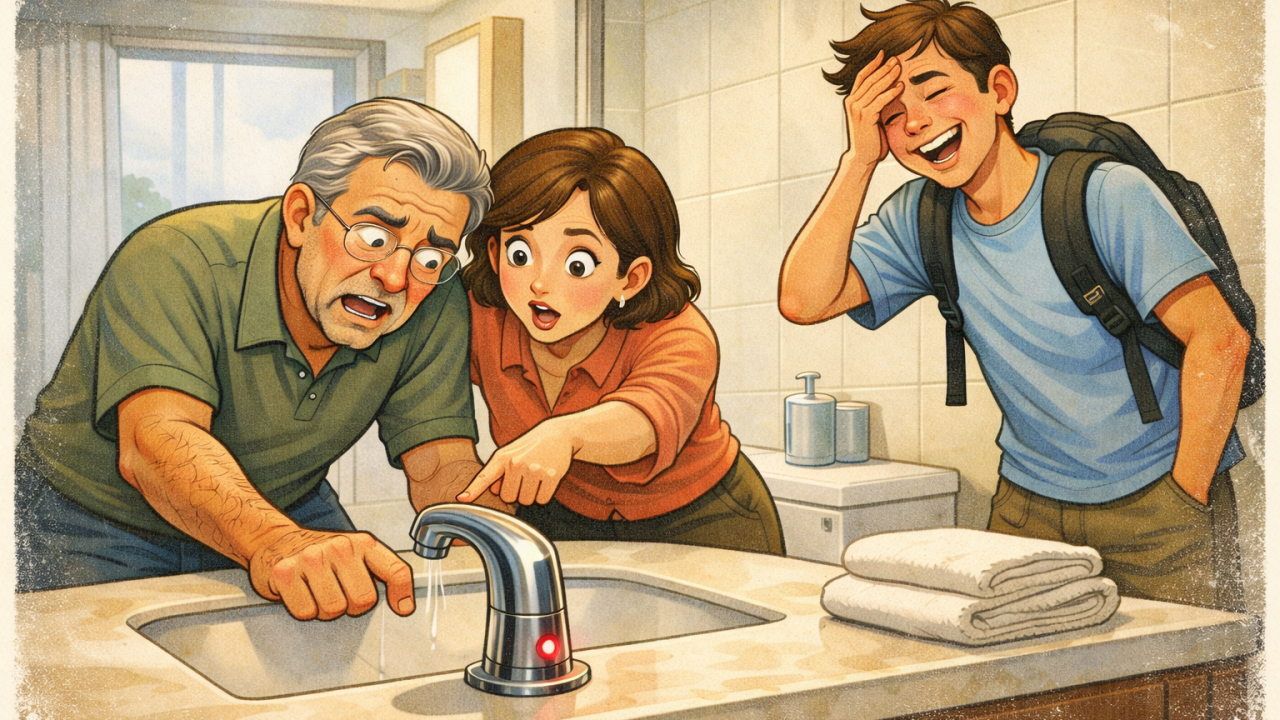
When I was very young, my parents and I took a trip to Athens, Greece. We stayed at a hotel, and in the bathroom, there was something we had never seen before: a faucet with a sensor. You put your hands underneath, and the water magically comes out.
To me, it was the future.
To my parents, it was an emergency.
I still remember my dad marching down to the front desk, deeply concerned, to announce that the faucet was broken. Not “maybe it’s broken.” Broken. Defective. Dangerous, probably. And my mom was right there with him, validating the situation like, “Yes, yes, we tried everything. No water. Very serious.”
Somewhere in that hotel, a poor employee had to explain that the faucet was not broken. It was just… smarter than we were.
And the funniest part is that this wasn’t ancient history. This was maybe twenty-something years ago. It’s not like we were in the 1800s discovering electricity. It was a faucet. A faucet that could sense hands. And it completely short-circuited our understanding of reality.
I think about that story a lot now, because in a weird way, 2026 sometimes feels like we’re all standing at the front desk again, trying to explain that something is broken, when actually the world just changed underneath us.
But here’s the part that makes it more than a funny travel story.
Today, my parents are both very sick. Alzheimer’s and Parkinson’s. The kinds of diseases that don’t just affect memory and movement. They reshape identity. They shift the atmosphere in a home. They introduce a loneliness that isn’t always visible from the outside.
And technology, the thing my father feared, is also one of the things that makes life a little easier now.
One of the most meaningful things I’ve done this year is build a custom GPT for my father in our native language. He can talk to it and ask questions about both diseases in the way he naturally thinks and speaks. And my dad, who once escalated a sensor faucet like it was a hotel crisis, now has an AI that he can ask, “What should I expect next?” or “Why is this happening?” or “What does this symptom mean?”
Does it cure anything? No.
But it helps his mental state. It gives him a sense of agency. It gives him something steady to talk to on days when the world feels confusing and small. It meets him where he is, without judgment, without fatigue, without making him feel like a burden for asking the same question twice.
And there’s another layer that still gets me. I’m the one who built it. Me. The kid who went to law school and then transitioned into technology. That fact alone would have sounded ridiculous to my younger self. It’s also a reminder of how accessible this technology has become for our generation. The tools are powerful, but they’re also closer to everyday life than ever before. In some ways, my parents’ generation missed out on that bridge. They missed out on the years where technology could have been a companion, not a threat.
So when I talk about being grateful to work in this time, I’m not only talking about the pace of innovation. I’m talking about moments like that, where a human need meets a new kind of capability, and for a second, the future feels less like disruption and more like care.
This brings me to what I think is the most strategically interesting shift happening right now: Agentic Commerce.
We are watching the industry collectively lean forward. Major players are pushing toward agent-enabled payments and commerce experiences. Everyone is experimenting. Everyone is moving. And it’s easy to feel like we are already behind.
But I honestly think we’re still at the beginning.
The real question isn’t technical. It’s marketplace-level.
What happens when every surface becomes a marketplace opportunity?
If intent can show up anywhere, and discovery becomes conversational, and the “storefront” can be an interface you don’t control, then we need to rethink what it means to be present. We might be moving into a world where “being findable” is not a channel strategy. It is the strategy.
And yes, there’s a provocative question inside that: will websites matter in five to ten years? I don’t think it’s a clean yes or no. Websites won’t disappear overnight. But the center of gravity may shift upstream, into the conversation, into the moment a customer says, “I need something for Friday night, I don’t want to think too hard, and please don’t make me return it.”
In that world, we need to position ourselves to meet the customer wherever intent is strongest. That means optimizing every surface, including our own. And it means being humble about timing. Agentic checkout will come, but adoption curves are not something we can manifest with optimism. Consumers adopt when it is genuinely better, not just new. Ecosystems mature when identity, fraud, returns, and accountability are solved, not when a demo looks magical.
So the posture I’m trying to hold is this: stay ready, stay visible, and don’t confuse speed with certainty.
Then there’s post-purchase, which I used to think of as the “after” part of the journey. In 2026, I’ve stopped thinking of it that way.
The lines are blurring so much that waterfall phases feel like an internal artifact more than a customer reality. The agent that helps you ask “where is my order?” is increasingly the same kind of intelligence that can help you choose the right item in the first place. The same system can recommend, explain, reassure, troubleshoot, and learn your preferences over time.
So post-purchase becomes table stakes, yes. But it also becomes brand-defining. Because when something goes wrong, customers don’t remember your org chart. They remember whether you showed up. Whether it was easy. Whether it felt respectful. Whether they felt like a person.
One more thing I can’t shake: we still haven’t seen the AI device revolution yet.
We are using this technology on devices that were not designed for it. We’re basically running a new operating system on old hardware and pretending that’s the end state. When the device layer shifts, interaction patterns will shift again. We don’t need to predict the exact form factor to plan for that. We just need to build strategies that are resilient to interface change.
And now, the part I care about most.
The human part.
I believe the AI that remembers you is fundamentally better than the AI that does not. From a customer perspective, that’s obvious. Remembering preferences, context, fit, style, what mattered last time. That’s how you reduce friction in a way that feels like care.
But “remembering” sits on a thin line. Helpful on one side. Creepy on the other.
The difference is trust, transparency, and control.
Data security and privacy are still developing in this space. That means we don’t get to treat them as checkboxes. They need to be foundational. Baked in. Designed deliberately. And as product leaders, we don’t get to outsource that responsibility. We can and should partner with Legal and Security and data teams, but we set the tone in what we ask for, what we allow, and what we refuse to build.
If 2025 taught me anything, it’s that being people-first is not a slogan. It’s a daily set of decisions. Choosing clarity over hype. Choosing guardrails over shortcuts. Choosing long-term trust over short-term lift.
I’m optimistic. Truly. This era could become one of the most meaningful leaps in how we learn, work, create, and care for each other.
And I’m cautious too. Because uncharted territory always comes with hidden risks, and the costs are rarely distributed evenly.
Maybe my father wasn’t warning me about technology after all. Maybe he was warning me about forgetting who technology is for.
I’m trying not to forget.
Subscribe to Field Notes
Get my latest essays on Enterprise AI and Agentic Commerce delivered straight to your inbox.