What If 95% of AI Pilots Aren’t Failures… But the Road to Progress?
August 27, 2025
We Call It Failure. History Calls It the Path to Breakthroughs.
The Elephant in the Room
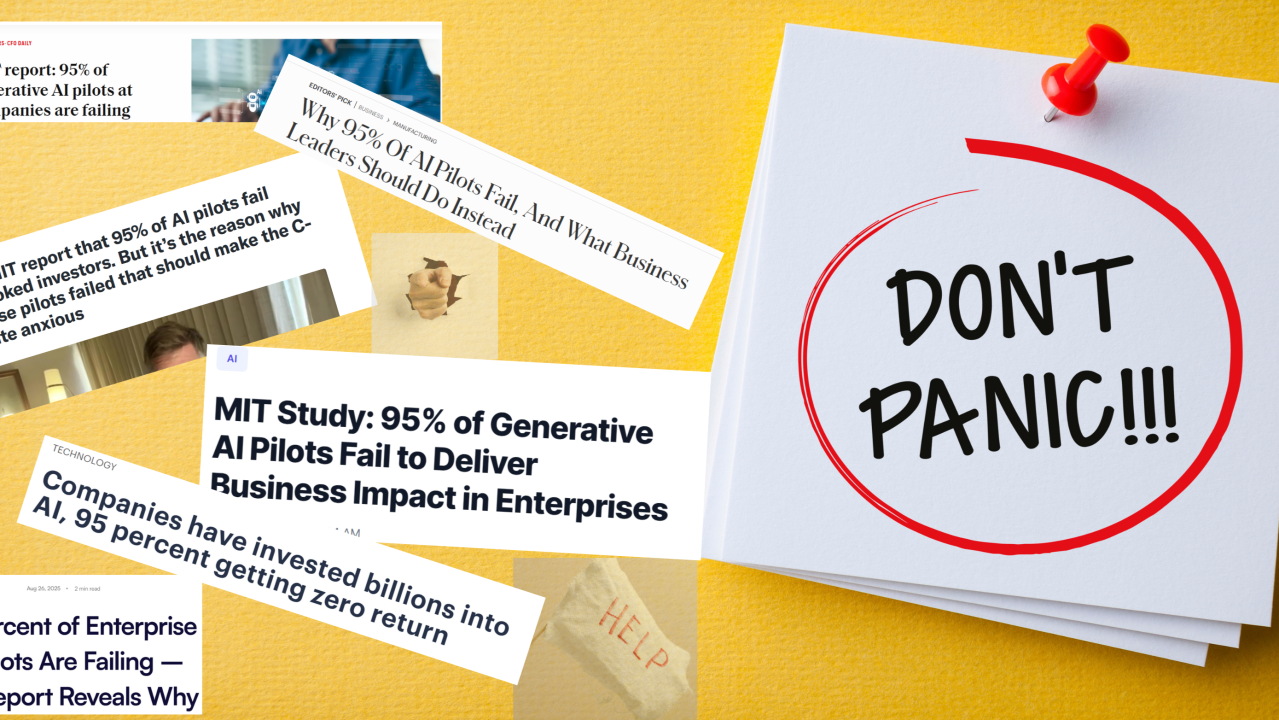
The other day I came across a Forbes article that cited new research from MIT’s Media Lab, and one line hit me hard:
“95% of AI pilots fail.”
I’ll be honest, my first reaction was probably the same as yours, that sounds like a disaster. Billions invested, so many smart people working tirelessly, and still most projects stall in what is now being called pilot purgatory.
But the more I sat with it, the more I realized, we can’t look at this as just a 95 to 5 ratio.
Because innovation does not live in ratios. It lives in the messy middle, in the experiments, in the learnings, in the things that do not work but teach us what will.
If we only focus on the 95, we miss the point. And if we only glorify the 5, we oversimplify the journey. The truth is, both matter. The 95 percent are the training ground, the 5 percent are the breakthroughs, together they are the rhythm of progress.
And when you look closely at the 5 percent that succeed, you see something interesting. They are not succeeding because their models are inherently smarter, they are succeeding because their systems are more humble.
Instead of being confidently wrong, they are tentatively right. They admit uncertainty instead of bluffing, they quantify confidence so people know when to double check, they learn continuously from human feedback, creating what MIT calls an accuracy flywheel, and they integrate directly into real workflows instead of floating around as shiny side projects.
What that shows us is simple but powerful, trust is the real differentiator.
And isn’t that true in life too? We do not put our trust in the loudest person in the room, we trust the one who admits what they do not know. Socrates said it best, “The only true wisdom is in knowing you know nothing.”
If AI can embody that kind of humility, if it can say “I don’t know”, if it can learn, adapt, and grow with us, then maybe more of those 95 percent will become part of the 5.
Because in the end, it is not about percentages. It is about progress. And progress, just like trust, is built one step at a time. So do not panic when you hear that number. Do not let it discourage you. What it really represents is learning at scale. Thousands of experiments that teach us what works, what does not, and what needs to change before it can truly make an impact.
I do not see the 95 percent as wasted. I see them as progress in motion. And when you view it that way, the story shifts. It is no longer 95 versus 5, it is one continuous cycle of discovery, where every test, no matter the outcome, moves us closer to building something safer, smarter, and more human.
Failure as the Path to Progress
When I think about failure in innovation, I do not think of spreadsheets or quarterly reports. I think of humanity.
Think of a child learning to ride a bike. The wobbles, the falls, the scraped knees. If you measured success by the first ride, you would call it a failure. But we know better, the falls are what make the balance possible.
History is full of examples like this. The Wright brothers did not just decide one day to fly, they crashed more times than anyone could count before Kitty Hawk. Jonas Salk’s vaccine trials were not instant victories, they were years of testing, refining, and retesting. Edison gave us the lightbulb not in a single flash of brilliance, but through thousands of attempts that did not work.
We do not look back on those moments as wasted effort. We see them for what they were, stepping stones.
So when I hear that 95 percent of AI pilots do not make it, I do not see a cautionary tale. I see a familiar story. A story as old as human progress itself.
Henry Ford once said, “Failure is simply the opportunity to begin again, this time more intelligently.” That is exactly what these pilots are, opportunities to begin again but smarter, opportunities to uncover what does not work so we can double down on what does.
Failure, in this sense, is not the opposite of success. It is the path to it.
Innovation in the Everyday
The reason we are seeing this high rate of stumbles is not because the technology is weak or because people do not know what they are doing. It is because, for the first time in history, we can test fast, learn fast, and move fast.
And in order to move fast, we also have to fail fast.
Innovation used to be locked up in labs. It took years of planning, millions of dollars, and entire departments just to attempt something new. That meant failure was rare, but only because the bar to even try was impossibly high.
Now, innovation is in the everyday. It is not locked in a research center, it is right here on our laptops, in our phones, and in the cloud tools we use at work. Because it is so accessible, it just makes sense that a lot of things will not work before we find the ones that do.
And that is not a problem. That is the process.
Take eCommerce, for example. On the surface, placing an order looks like a click and a delivery. But in reality, it is a long journey. The late night scroll from a parent finally getting five minutes of peace, the teenager proudly buying their first pair of jeans with their own money, the checkout moment where trust matters most, the invisible steps in the background, payments, fraud checks, inventory updates, shipping, returns.
AI now touches all of these points. And the beauty of today’s world is that we can experiment with them, safely and quickly, in ways that were impossible just a few years ago.
Some experiments will stumble, some will frustrate us, some will flat out not work. But others, the ones that succeed, will transform how we shop, how we connect, how we live.
The ones that do not succeed are not wasted, they are the necessary stepping stones that get us there.
Measuring What Matters
Now that innovation lives in the everyday, we have to rethink how we measure success.
If we only measure in dollars and percentages, we will miss the bigger picture.
Yes, ROI matters. Conversion rates, cost savings, time to checkout, those are important. But if we reduce innovation only to what shows up in the next quarterly report, we risk overlooking the very things that make technology meaningful.
Albert Einstein once said, “Not everything that can be counted counts, and not everything that counts can be counted.”
And Maya Angelou reminded us, “People will forget what you said, people will forget what you did, but people will never forget how you made them feel.”
A checkout that is two seconds faster means nothing if customers feel less secure. An automated chatbot that answers instantly is worthless if the customer walks away frustrated. A model that saves employees time is not a win if it leaves them feeling disempowered.
So yes, measure ROI, but also measure trust, ease, confidence, delight.
I have seen this firsthand. In one retail pilot, the numbers showed little immediate financial lift, but the customer feedback told another story. They felt more confident in sizing, more reassured about their choices, and less likely to abandon their carts.
That confidence does not show up in a P&L statement, but it shows up in loyalty, in repeat visits, in brand trust.
And if we want AI to truly work, we have to measure both sides, the numbers and the human experience.
Because in the end, innovation is not just about efficiency. It is about trust.
How to Move Fast Without Losing Safety
Here is something I have learned the hard way, yes, you should move fast. In fact, you must.
Do not get stuck overthinking. Test quickly, learn quickly, and if something does not work, call it a learning and move on.
But there is one thing you can never afford to break, and that is safety and security.
Too many teams treat Legal, Privacy, and Security as the last stop on the journey, a box to check at the end. By then it is too late. That is when projects stall, trust gets damaged, and weeks of effort unravel.
What I have seen instead is that when you bring those partners in from the very beginning, not as roadblocks but as allies, you actually move faster. Problems surface early, trust is built from day one, and the team feels safer pushing forward because the foundation is solid.
So yes, move fast, run the pilots, push the boundaries, even fail fast if you must. But never fail on safety.
Because here is the truth, customers might forgive a feature that needs a few more iterations, but they will not forgive you if you break their trust. And once trust is gone, no amount of innovation can win it back.
That is why I tell every team I work with, move fast, fail fast, learn fast, but never fail on safety.
If you remember that, you get the best of both worlds, the agility to keep pace with this extraordinary moment in technology, and the integrity to build something that lasts.
Human First, Always
People often talk about building an AI first future. But here is what I believe, AI first must always mean human first.
Because technology, at its best, should amplify humanity, not replace it.
One of the reasons we can afford to test fast, and even fail fast, is because the cost of testing has dropped dramatically. What once required massive infrastructure and million dollar budgets can now be run as a lightweight pilot, sometimes with nothing more than cloud access and a handful of people.
That is why we are seeing so many experiments, because we can, because it is accessible, because the barrier to entry has never been lower.
But just because we can test fast does not mean we should lose sight of why we are testing in the first place. Every experiment, whether it works or not, has to be in service of people, customers, employees, communities.
And this matters more than ever, because generations are growing up with entirely different expectations of technology.
For some of us, waiting a week for film to be developed was normal. For today’s kids, the idea of not being able to undo instantly is unthinkable. For tomorrow’s generation, AI will be part of daily life, as natural as electricity is to us.
That is why empathy has to sit at the center of this work.
Satya Nadella said, “Empathy is the key to innovation.” And I could not agree more.
If we lose empathy in this journey, if we forget that it is real people on the other side of the screen, then no amount of technology will save us.
But if we center every test, every pilot, every innovation on empathy, then even the stumbles will move us forward. They will bring us closer to a future where technology serves humanity, not the other way around.
And to me, that is not just the right way to innovate, that is our responsibility.
The Privilege of Right Now
Sometimes I take a step back and think, what a time to be alive.
We are the first generation to have these tools at our fingertips. Tools that let us test faster, build smarter, and reach further, not with billion dollar labs and endless timelines, but with a laptop and a few weeks of focus.
That is not something to fear, that is something to embrace.
Because yes, many pilots may not make it, but when the cost of testing has dropped so dramatically, those stumbles are not disasters, they are gifts. They are opportunities to learn at a speed humanity has never known before.
It is a privilege to work in technology today, but it is also a responsibility.
Our duty is not just to innovate for business metrics. It is to innovate for people. For customers who want to feel understood. For employees who deserve tools that empower them. For the next generation who will inherit what we build today, and who will live with the consequences of whether we built it with empathy, safety, and responsibility at the core.
Albert Einstein put it simply, “Failure is success in progress.”
And maybe that is the real story here.
95 percent of AI pilots do not fail. 95 percent of AI pilots are simply success in progress.
And if we can hold onto that mindset, if we can move fast but safely, measure both numbers and feelings, and always keep humans at the center, then we will not just make innovation work for business. We will make it work for life.
Because in the end, this is not just about AI. It is about us. It is about people. And it is about the privilege of building a future worthy of the humans who will inherit it.
Subscribe to Field Notes
Get my latest essays on Enterprise AI and Agentic Commerce delivered straight to your inbox.